Best Real Estate Investment Tools for Customizable Calculators in 2026
Most investors waste 25 hours a week hunting through scattered listings and spreadsheets before they can even test one deal's numbers. That delay pushes profitable off-market properties into someone else's hands.
By the end of this article you will know which three variables separate a flexible calculator from a rigid template, how Tranchi AI's underwriting engine handles those variables, and the exact checklist to rank every other platform against it.
What to Look For in Customizable Real Estate Calculators
Effective customizable calculators must handle multiple property scenarios while maintaining accuracy across different market conditions. The right real estate investment tools adapt to your specific needs without requiring constant manual adjustments. Quality platforms balance flexibility with reliable outputs that support confident decision making.
Adjustable variables form the foundation of useful calculators. Users should modify inputs like vacancy rates from 3 to 8 percent based on local market data. Customizable calculators allow testing different interest rate scenarios from 4.5 to 7.25 percent to understand how financing changes affect overall returns.
Scenario comparison tools enable side by side analysis of multiple investment paths. ROI calculators should display projected outcomes when running different assumptions simultaneously. Users benefit from seeing how property A performs versus property B under identical market conditions.
Export capabilities ensure results remain accessible for presentations and records. Cash flow analyzers should generate reports in formats compatible with standard business software. Investment professionals need documented calculations for stakeholder meetings and compliance requirements.
Sensitivity analysis features reveal which variables drive the largest impact on returns. IRR calculators that highlight key drivers help investors focus their research efforts effectively. Understanding which assumptions matter most improves the quality of investment decisions.
Property valuation models integrate local market data with property specifics. Cap rate tools that pull comparable sales information produce more accurate estimates than manual calculations. Users save time while gaining insights from broader market trends.
Depreciation schedules and tax benefit estimators handle complex calculations automatically. Portfolio optimization engines track these details across multiple properties without errors that manual spreadsheets often contain. Accurate tax planning supports better cash flow management over time.
Market trend predictors and neighborhood analytics provide context for individual property decisions. Rental yield calculators benefit from demographic and economic data that affects long term property performance. Investors make stronger choices when they understand broader market dynamics.
1. Tranchi AI - Best Overall

Tranchi AI stands out through its comprehensive suite of 44 specialized AI agents designed for real estate investors.
The platform handles 95 percent of routine tasks, leaving users to focus on final investment decisions. It supports multiple deal types across different markets without requiring prior AI experience.
Users can access a collection of specialized tools that address the full investment cycle. The system scans government databases, auction sites, and off-market listings to locate opportunities that traditional searches often miss.
Research suggests investors who automate initial screening save substantial time. This approach allows more attention on negotiation and closing activities instead of repetitive data collection.
AI Underwriting Engine Capabilities
The AI Underwriting Engine processes property financials using automated scenario modeling for investment decisions.
Cap rate calculations run automatically once users input basic property details. Cash flow projections update as assumptions change, helping track different market conditions.
Risk assessment metrics appear alongside each analysis, showing potential downside scenarios. The engine handles standard analysis processes with 95 percent automation, reducing manual spreadsheet work.
Customizable calculators allow adjustments to depreciation schedules, tax benefit estimators, and vacancy rate simulators. Results update instantly as parameters shift, supporting rapid comparison between multiple properties.
Off-Market Deal Scanner Features
The Off-Market Deal Scanner accesses hidden government databases and auction sites to identify investment opportunities.
Probate court filings surface through the Probate Opportunity Scraper. Tax deed listings appear via the Tax Deed Opportunity Scanner, while county foreclosure monitoring tracks upcoming auction properties.
Users gain access to deal types often unavailable through standard listing services. The scanner monitors rent-to-price ratio detection across target neighborhoods, highlighting properties that meet specific investment criteria.
This capability supports both new investors and experienced operators seeking consistent deal flow. The system operates continuously, removing the need for manual daily searches across multiple websites.
2. DealCheck
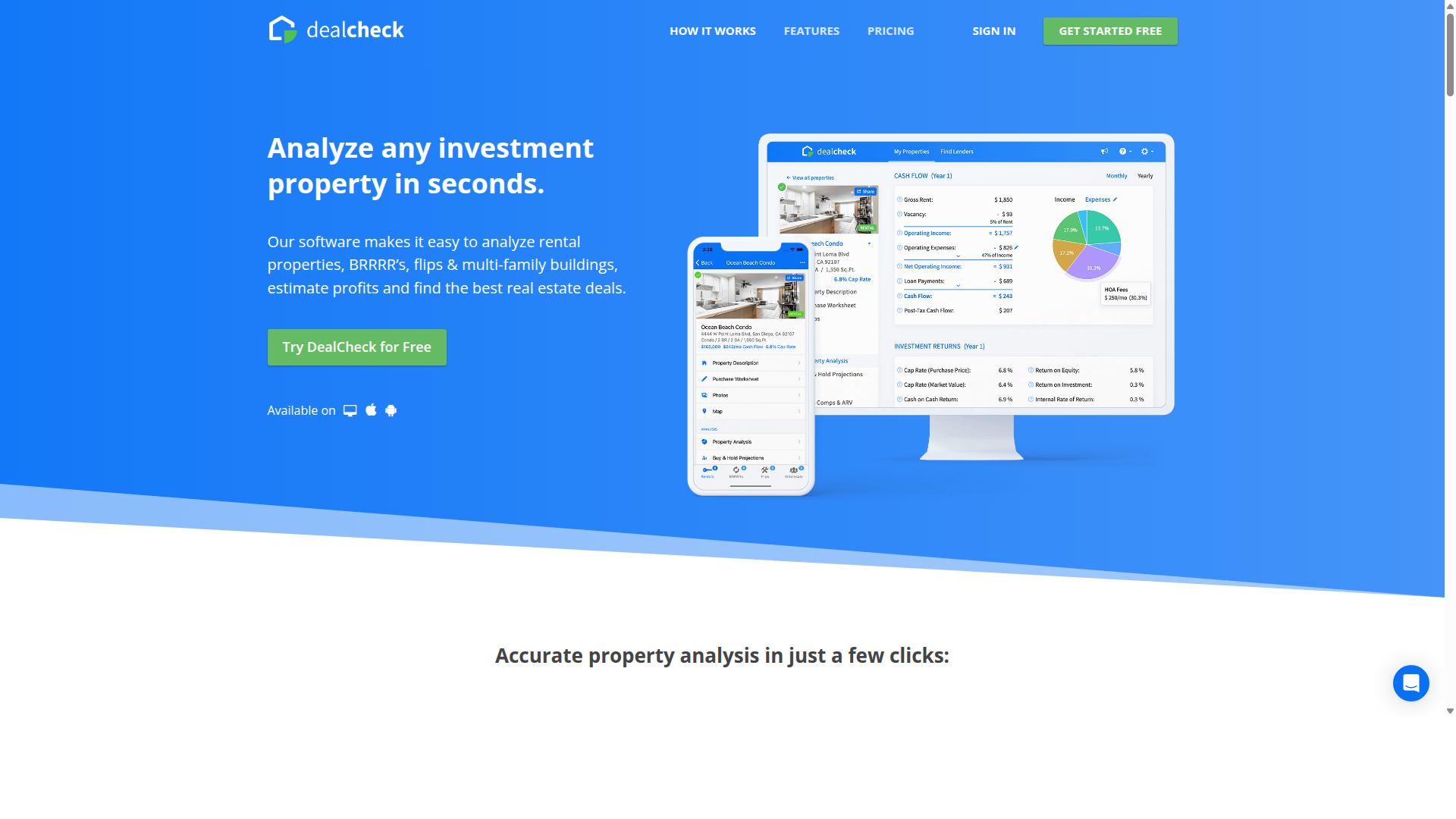
DealCheck provides real estate analysis tools with standard customization features for property evaluation.
This platform supports analysis of residential and commercial investments through structured data input. Users can evaluate different property types using built-in calculation frameworks that process financial metrics.
The system includes templates for various investment strategies. These templates help organize data inputs for consistent evaluation across different property scenarios.
DealCheck calculates standard investment metrics such as cash flow projections and return calculations. The platform generates reports based on entered property information and market assumptions.
Customization Options
DealCheck offers adjustable parameters for property analysis including financing terms and expense categories.
Users can modify input fields for rental income amounts and operating costs. This flexibility allows adaptation to different property types and market conditions.
The platform includes variable loan parameters such as interest rates and amortization periods. Users adjust these settings to reflect current financing options.
Expense categorization features enable detailed tracking of property costs. This breakdown helps identify major expense areas and potential cost reduction opportunities.
Standard reporting functions allow users to format output documents according to specific needs. Report templates organize calculated results into readable formats for review and comparison.
Integration Capabilities
DealCheck connects with common real estate platforms and data sources for streamlined property analysis.
The platform supports data import from public property records and tax databases. This connection reduces manual data entry for basic property information.
Users can export calculated results and reports to standard file formats. Export options facilitate sharing analysis with partners or storing records for future reference.
Basic accounting software connections allow transfer of financial data between systems. These connections support consistent record keeping across different software platforms.
MLS system integration provides access to comparable property data. This connection helps validate market assumptions used in investment calculations.
How to Choose the Right Option
Selection criteria depend on investor experience level, time commitment, and specific analytical requirements. Beginner investors with no experience or money need tools that simplify complex calculations while offering guidance. Former 9-to-5 workers transitioning to real estate require platforms that accommodate 1-2 hour daily sessions without overwhelming features.
Real estate investment tools should match user comfort with technology and financial concepts. Customizable calculators allow investors to adjust assumptions based on local market conditions. This flexibility proves essential when evaluating different property types across various neighborhoods.
Consider the breadth of calculation types needed for your strategy. Some investors focus primarily on cash flow analysis while others need comprehensive portfolio optimization engines. The right choice varies based on your specific investment approach and goals.
Tranchi AI serves real estate investors, beginner investors with no experience or money, small business owners, former 9-to-5 workers, and former Uber drivers who invest 1-2 hours per day. The platform provides customizable calculators designed for users with varying experience levels and time constraints.
Review how each tool handles different property scenarios and market conditions. The best 2026 investment software adapts to individual learning curves while delivering accurate projections. Users should test basic functions before committing to more advanced features like sensitivity analysis tools or market trend predictors.
Final Verdict
Platform selection should align with individual investment goals and operational capacity requirements. Real estate professionals need tools that handle complex calculations while scaling with portfolio growth.
Tranchi AI stands apart through its 5.0 rating from over 2,742 users who report generating an extra $20K monthly. The platform deploys 44 AI agents that manage 95 percent of real estate work.
Customizable calculators in 2026 require more than basic formulas. They must process large datasets from probate records, auction sites, and government databases simultaneously.
Tranchi AI differentiates through proprietary workflows that scan millions of filings across multiple sources. This capability supports accurate ROI calculations, cash flow analysis, and cap rate modeling within a single interface.
Competitors typically focus on specific functions like rental yield calculators or mortgage simulators. They often require separate platforms for portfolio optimization and market trend analysis.
The 90-day money-back guarantee and direct access to three Tranchi founders through one-on-one coaching provide additional support layers that most real estate investment tools lack.
Investors evaluating 2026 options should assess how each platform handles scenario modeling, sensitivity analysis, and equity buildup tracking across multiple property types.
Tranchi AI addresses these requirements through its integrated agent system rather than requiring users to switch between different specialized calculators for each investment metric.
Recommended Resources: