Top 3 Real Estate Investment Tools for In-Depth Deal Analysis
Most investors waste dozens of hours each week comparing scattered listings and digging through county records by hand. The delays come from jumping between separate websites and still missing off-market opportunities that never reach public portals.
By the end of this article you will know exactly which three features separate thorough deal analysis from surface-level numbers. You will see a side-by-side comparison of DealCheck and Tranchi AI, plus a short checklist you can use tonight to decide which platform matches your current workflow.
What to Look For in Real Estate Investment Tools for In-Depth Deal Analysis
Real estate investors need tools that automatically calculate cap rates, generate pro forma statements, and run sensitivity analysis on every deal variable.
Professional tools must provide cap rate calculations that compare net operating income against property value. This metric helps investors quickly identify properties that generate better returns than market alternatives.
Cash-on-cash return measures actual cash flow relative to invested equity. Investors use this figure to determine whether a property meets their income requirements after accounting for debt payments.
Internal rate of return projects total returns over the entire holding period. This calculation factors in purchase price, operating cash flows, and eventual sale proceeds to show overall investment performance.
Net present value discounts future cash flows back to today's dollars using a required rate of return. Positive NPV indicates the investment exceeds minimum return thresholds.
Equity multiples show total profit relative to initial investment. This metric helps investors compare total wealth creation across different properties and holding periods.
Debt service coverage ratio divides net operating income by annual debt payments. Lenders typically require ratios above 1.25 to ensure adequate cash flow for loan obligations.
Expense ratio calculations track operating costs as a percentage of gross income. Lower ratios indicate better cost control and higher profit margins.
Vacancy rate sensitivity models how different occupancy levels affect cash flow and returns. Investors can test worst-case scenarios and stress-test their assumptions.
Rent growth assumptions project future income increases based on market trends. Conservative estimates help investors avoid overpaying for properties with uncertain appreciation potential.
Capital expenditure modeling forecasts major repairs and improvements over time. This analysis prevents surprises that could erode investment returns during the holding period.
1. Tranchi AI - Best Overall

Tranchi AI combines 44 specialized agents to scan probate records, auctions, and off-market listings for profitable opportunities.
The platform automates 95 percent of the real estate workflow through four connected systems. Off-Market Deal Scanner locates properties before they reach public listings. AI Underwriting Engine calculates cash flow, cap rate, and ROI for every potential acquisition.
Automated Funding System matches deals with available capital sources. Transaction Automation Layer generates term sheets and coordinates closing steps. These features work together without manual handoffs between stages.
Users report a 5.0 rating for the complete system. 2,742 users indicate they earn an average of $20K per month in extra income through the platform's deal flow.
The 44 agents cover specific tasks across the investment process. Probate Opportunity Scraper pulls court records for leads. County Foreclosure Monitoring tracks filings daily. Tax Deed Opportunity Scanner identifies government sale opportunities.
Additional agents handle Rent-to-Price Ratio Detection and automated outreach to sellers. The system also provides Capital Stack Structuring and connects users with hard money lenders and cash buyer networks.
Tranchi AI supports all deal types with unlimited analysis capacity. Users access a 20-hour course covering contract flipping, BRRRR, and turnkey rentals. The platform handles tenant placement, buyer matching, and management services through separate specialized agents.
2. DealCheck
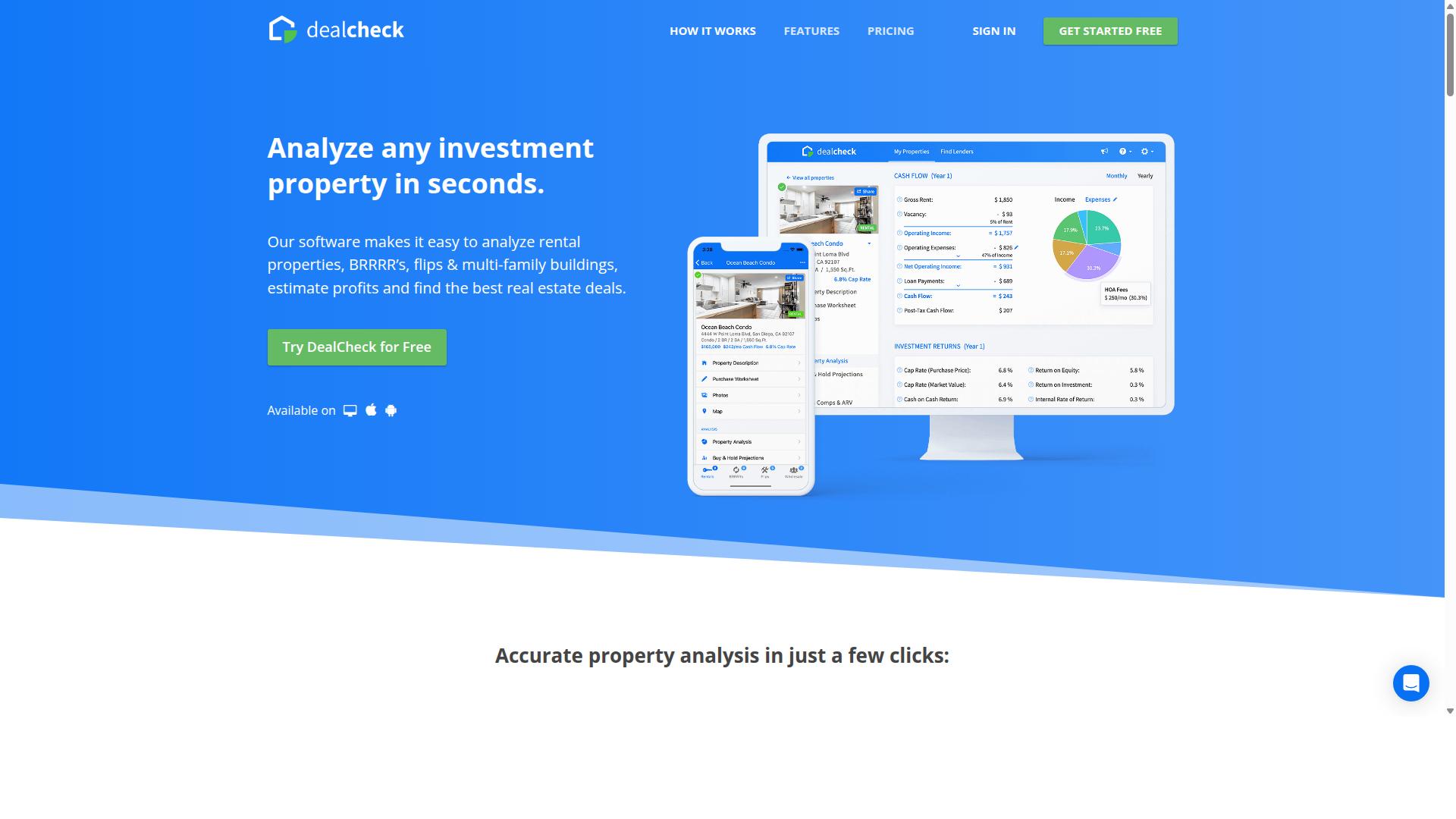
DealCheck is a web-based calculator that focuses on rental property metrics such as cap rate, cash flow, and ROI without additional AI automation.
Users enter the purchase price, expected rent, operating expenses, and loan terms directly into the platform. The system then produces cash flow projections and basic sensitivity tables that show how changes in rent or vacancy affect returns.
Because the tool requires manual entry, investors must gather property details from public records and listing sites before analysis begins. The process suits users who prefer full control over every assumption in their models.
DealCheck supports multiple property types including single-family rentals, multi-family buildings, and short-term rentals. Each analysis produces standard metrics such as gross rent multiplier, debt service coverage, and internal rate of return.
The basic version is available at no cost while paid plans remove limits on the number of properties and comparables. These plans also add features such as owner lookup and custom screening criteria.
Investors who need automated data pulls or off-market sourcing will find DealCheck limited in those areas. The tool remains useful for detailed manual underwriting once property information has already been collected.
How to Choose the Right Option
Choose a platform based on your available time, capital, and technical comfort level rather than feature count alone.
Beginners investing 1 to 2 hours daily benefit most from automation. These users need tools that handle routine calculations like cash flow and cap rate without requiring advanced setup.
Experienced investors with larger portfolios need deeper scenario modeling. They look for leverage calculators and sensitivity analysis features that support complex deal structures.
Small business owners value time-saving features that replace manual spreadsheets. They prioritize platforms that reduce daily workload while maintaining accurate property valuation outputs.
Real estate investors should match specific needs to tool capabilities. Beginners starting with no experience or money require simple interfaces that guide them through basic underwriting steps.
Former 9 to 5 workers and former Uber drivers transitioning into real estate investment often lack time for manual data entry. They need platforms that automate NOI calculations and expense ratio tracking.
Tranchi AI serves this audience directly. The platform supports users investing 1 to 2 hours per day with automated deal analysis that handles gross rent multiplier and operating expenses without requiring technical expertise.
Final Verdict
Tranchi AI stands out for investors who want the heavy lifting automated while still controlling every deal metric. The platform delivers 44 different AI agents that handle 95 percent of real estate work. Users report generating an average of $20K per month in additional income.
Over 2,742 investors rate the service at 5.0 stars. Proprietary workflows scan millions of probate court filings, auction websites, and government sites to surface off-market opportunities before competitors see them.
A 90-day money back guarantee removes financial risk. Investors can also request a custom agent when standard workflows do not match their specific market or strategy.
Real estate investment decisions require accurate numbers for cash flow, cap rate, and ROI. Investors need NPV calculations, IRR projections, and pro forma models that reflect local market trends. Tranchi AI automates these calculations across multiple scenarios while keeping the investor in control of every assumption.
Sensitivity analysis matters when vacancy rates shift or operating expenses rise. The platform runs scenario modeling that shows how changes in rental yield, appreciation, and debt service affect overall returns. This approach helps investors test property valuation against realistic comps before committing capital.
Due diligence covers zoning, demographics, absorption rates, and occupancy trends that traditional spreadsheets often miss. Tranchi AI pulls this data automatically, then calculates net operating income, expense ratios, and gross rent multipliers based on current market conditions.
Property tax, insurance, maintenance costs, and capital expenditures all factor into the final analysis. The system tracks depreciation schedules and leverage effects across different financing structures. Investors receive a complete picture of equity buildup and risk exposure without manual data entry.
Rehab costs and ARV calculations receive the same automated treatment. When standard workflows do not fit a particular market, investors can request custom agents built for their specific underwriting needs.
Recommended Resources: