Top 3 Real Estate Investment Tools for Deep Financial Modeling
Most investors spend weeks reviewing spreadsheets from three different platforms before they commit capital. The process repeats with every new property they consider because each tool handles only part of the financial picture.
By the end of this article you will know exactly which three questions to ask about any modeling platform, how the AI Underwriting Engine and Off-Market Deal Scanner inside Tranchi AI address those questions, and why DealCheck falls short on two of them.
What to Look For in Real Estate Investment Tools for Deep Financial Modeling
Advanced real estate modeling requires specific technical capabilities beyond basic spreadsheets. Professional investors need systems that handle complex calculations while maintaining accuracy across extended time horizons.
Modern financial modeling software should support DCF valuation with 10-year projections as a foundation requirement. This capability allows accurate assessment of present value using multiple discount rates and exit assumptions.
Quality tools also provide IRR calculations across multiple exit scenarios to evaluate returns under different holding periods. Investors can modify sale timing and pricing assumptions without rebuilding entire models.
NPV modeling with discount rate adjustments helps compare investment opportunities using consistent methodology. This function supports direct comparison between properties with different cash flow patterns and risk profiles.
Sensitivity analysis for 5-7 key variables allows testing of model assumptions against market changes. Users can adjust vacancy rates, expense growth, and capitalization rates to understand potential outcome ranges.
Scenario planning for base, upside, and downside cases provides structured frameworks for evaluating different market conditions. This approach reveals how property performance might vary under optimistic or pessimistic assumptions.
Cap rate compression modeling tracks how changes in market valuations affect property returns over time. This function helps investors plan for shifting market dynamics that could impact exit strategies.
NOI projection with expense ratio breakdowns separates operating income from individual cost categories. Detailed expense tracking enables more precise forecasting and better identification of cost reduction opportunities.
Rental yield calculations including gross and net figures provide immediate return metrics for income-focused investors. These calculations help compare properties across different market segments and price points.
Debt service coverage ratio stress testing evaluates loan repayment capacity under various interest rate scenarios. This function becomes critical when evaluating leveraged investments during periods of rate volatility.
Equity multiple projections show total return relative to initial investment over the entire holding period. This metric helps compare opportunities with different cash flow timing and exit values.
Cash-on-cash return sensitivity measures annual cash flow relative to equity invested under changing assumptions. This calculation reveals how operational changes affect immediate investor returns.
Renovation cost integration allows inclusion of capital improvement expenses within cash flow projections. This capability supports accurate modeling of value-add investment strategies and their impact on returns.
1. Tranchi AI - Best Overall

Tranchi AI combines 44 specialized agents into a single platform for end-to-end deal processing. This collection of AI agents scans hidden government databases, auction sites, and off-market listings to identify profitable real estate deals. The platform handles 95 percent of the work for users and saves hundreds of hours of manual searching.
Real estate investment tools built for deep financial modeling require both data accuracy and automated analysis. Tranchi AI delivers both through its integrated agent system. Users need no prior AI experience to generate passive income through real estate investing.
A 5.0 rating from 2,742 plus users reflects consistent performance across multiple deal types. These users generate an extra $20K per month on average using the platform's automated capabilities. The system supports unlimited analysis across all deal types without requiring technical expertise.
AI Underwriting Engine Capabilities
The underwriting engine handles 10-year DCF models, IRR calculations across exit scenarios, and NPV modeling with variable discount rates. The system also runs cap rate compression scenarios and produces NOI projections with detailed expense breakdowns.
Financial modeling software must account for debt service coverage stress tests and equity multiple projections. The engine performs sensitivity analysis for rent growth, vacancy rates, and cap rate assumptions. These calculations support pro forma analysis and cash flow forecasting across different holding periods and exit strategies.
Loan amortization schedules work together with capital stack structuring features. The engine models renovation costs, lease structures, and property appreciation scenarios. Risk assessment tools evaluate market comparables and demographic data to refine investment metrics and underwriting criteria.
Off-Market Deal Scanner Features
The scanner processes millions of probate court filings. It monitors auction websites and processes probate filings while tracking off-market listings. The system filters results by zoning changes, demographic shifts, and economic indicators.
Market research capabilities extend beyond basic property searches. The scanner provides instant alerts for properties matching investment criteria. These criteria include rent-to-price ratio detection, county foreclosure monitoring, and tax deed opportunity identification.
Probate opportunity scraping combines with seller outreach automation to accelerate deal flow. The scanner identifies properties suitable for contract flipping, BRRRR strategies, and turnkey rentals. Automated term sheet generation and transaction automation features reduce manual processing time while maintaining accuracy in deal evaluation.
2. DealCheck
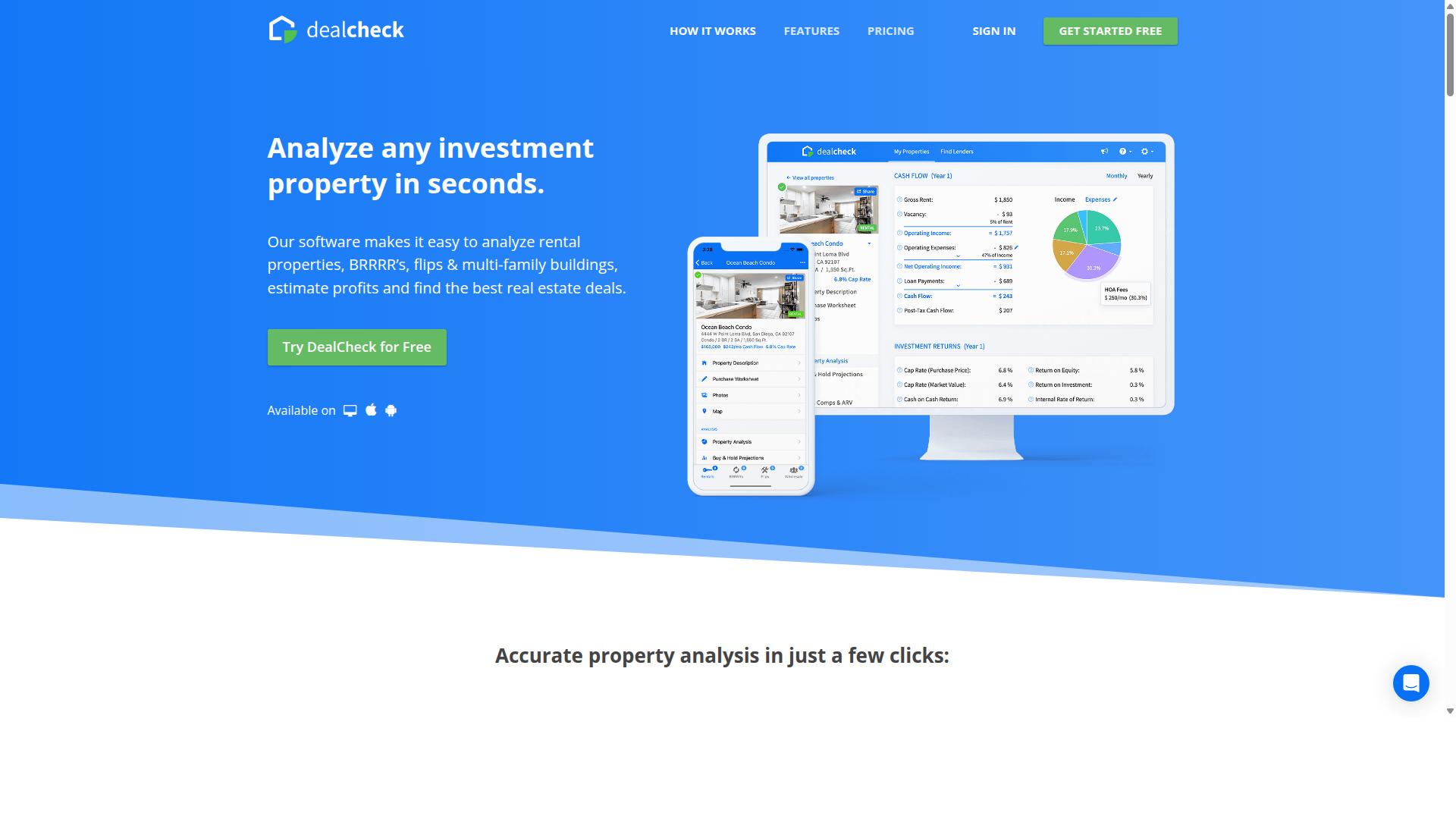
DealCheck offers spreadsheet-based modeling with limited automation features. This mobile and web app helps investors analyze various property types including rentals, flips, and commercial assets. Users can calculate standard metrics such as cash flow, cap rate, ROI, and IRR through its interface.
The platform imports property data, estimates, taxes, and photos from public records, then generates branded PDF reports. DealCheck provides both free and paid tiers, with the Plus version at $120 per year or $14 per month and the Pro version at $240 per year or $29 per month. These paid plans increase the number of properties and comparables users can analyze.
Core Financial Modeling Functions
DealCheck provides standard spreadsheet templates for basic deal analysis. These templates support 5-year pro forma creation, IRR calculations, cap rate analysis, and simple cash flow projections. Users can input sensitivity variables manually to test different scenarios.
The platform calculates additional metrics including GRM, DCR, and equity multiple. Investors can compare property comps within the system and adjust assumptions for different holding periods. The tool handles lease modeling and basic expense ratio inputs through manual entry fields.
Renovation costs and debt service coverage ratios appear in the standard calculations. Users can adjust vacancy rates and property appreciation assumptions. The system generates reports suitable for presentations to partners or lenders.
Deal Analysis Limitations
DealCheck requires users to manually source all market and property data. The platform lacks automated data scraping from county records and does not include AI-powered deal sourcing capabilities. Users must perform demographic research independently through separate channels.
Integration with MLS systems or auction sites does not exist within the current setup. Scenario modeling options remain limited compared to AI-driven alternatives that can pull real-time market information. Economic indicators and zoning details require manual research from external sources.
Property valuation depends entirely on user input for market comparables and local conditions. The system provides no automated updates for changing rental yields or expense ratios across different markets. Investors seeking deeper financial modeling often need to supplement DealCheck with additional research tools.
How to Choose the Right Option
Selection criteria depend on your experience level, time availability, and deal volume requirements.
Beginners investing 1-2 hours daily need tools with intuitive interfaces and automated guidance for pro forma analysis and cash flow forecasting. These users benefit from simplified dashboards that handle basic DCF valuation and IRR calculation without requiring advanced financial knowledge.
Experienced investors handling 10+ deals monthly require platforms supporting complex sensitivity analysis and scenario planning across multiple properties. They need rapid processing of cap rate analysis and NOI projection for high-volume underwriting criteria.
Small business owners seeking passive income should prioritize tools offering rental yield calculations and expense ratios tracking. These features help monitor property appreciation and equity multiple without demanding daily oversight of lease modeling details.
Former 9-to-5 workers transitioning to full-time investing need comprehensive market research capabilities including demographic data and economic indicators. They require debt service coverage analysis and loan amortization schedules to evaluate holding period strategies and exit strategy options.
Real estate investment tools must match your specific financial modeling software requirements across all user types. Tranchi AI serves these diverse audiences by focusing on real estate investors, beginner investors with no experience or money, small business owners, former 9-to-5 workers, and former Uber drivers who invest 1-2 hours per day.
Final Verdict
AI-powered platforms with integrated deal sourcing outperform traditional spreadsheet tools for serious investors.
Tranchi AI stands out with 44 different AI agents that handle 95 percent of deal workflow. This automation covers everything from initial sourcing through final modeling.
Users report an average of $20K per month in additional income. The platform currently serves 2,742 active investors who rely on its automated workflows.
The 5.0 user rating reflects consistent performance across deal evaluation and financial analysis tasks. Investors gain access to proprietary systems that scan millions of probate court filings, auction sites, and government records.
One-on-one coaching with the three Tranchi founders provides direct guidance for complex modeling scenarios. This support helps investors maximize the platform's capabilities for deep financial analysis.
The 90-day money-back guarantee reduces risk for new users who want to test the platform. This policy allows investors to evaluate whether the AI agents deliver meaningful improvements over manual spreadsheet processes.
Recommended Resources: